Blog
Is Over-Reliance on Google Ads Automation Slowing Your Paid Search Growth?

Over the past two decades working in the trenches of paid search, I've seen firsthand the dramatic evolution of Google Ads. In the early days, success came from rolling up your sleeves: manually managing bids, digging through raw search term reports, and optimizing campaigns through a mix of intuition, testing, and deep data analysis. I still remember refreshing spreadsheets late into the night just to adjust a handful of bids. Today, we're in a very different landscape, and Google now champions automation, from auto-apply suggestions to Performance Max campaigns, positioning machine learning as the path to "optimal" performance.
Yes, automation can be powerful. If you've seen the metrics on how quickly machine learning models can process enormous sets of data, you know its impressive. And if you're brand new to paid search, a simplified campaign structure could indeed prevent rookie mistakes. But advertisers who are serious about growth shouldn't simply defer to Google's automation at every step.
Advertisers who blindly follow Google's automation-first approach risk handing over control, and with it, limiting growth potential. With 20 years of experience building, restructuring, and scaling paid search campaigns, I've learned that relying on Google Ads automation without strategic oversight can be a costly mistake. When you give Google full control, you also give up visibility and agility, along with the ability to fine-tune your strategy for maximum return. If you're serious about growth, "set it and forget it" simply isn't good enough.
Let's now dig into why Google pushes automation so hard, how a "black box" approach can work against you, where automation truly shines, and how to use it judiciously as a tool, not a crutch, that maximizes returns.
Google's priority is Google
In any conversation about Google's automated features, I find it important to remember one core fact: Google is a publicly traded company with an obligation to drive consistent, ever-increasing profits for it's shareholders. Of course, the company wants advertisers to see decent results: if we don't, we'll pull our budgets. But Google's first priority will always be its bottom line. So when they talk about "best practices" or "recommending" certain campaign structures, we have to ask ourselves: best for whom?
Mainstream messaging vs. reality
The mainstream narrative from many Google reps and most agencies often goes like this: "Let the system do the heavy lifting. Machine learning can analyze user behavior better than humans ever could. Trust the algorithms; they'll manage bids and keywords more effectively than manual oversight."
Agencies frequently echo these statements because it can simplify their own workflow. If you're running a large agency with limited staff, setting up broad-match keywords with automated bidding is a quick, hands-off method to get campaigns going, and meet a minimum performance standard.
A "minimum performance standard" isn't what serious advertisers want. If you're in a competitive market or if you're looking to grow aggressively, you don't want "serviceable" results. You want to squeeze every drop of value from your ad spend. And that's where blind faith in automation might underdeliver.
Why would Google encourage it?
Google encourages these automated campaigns for a few reasons.
There are thousands of small businesses that know next to nothing about Google Ads, and automation is a one-size-fits-all solution that ensures they at least get something out of their budget without too many rookie mistakes.
The more the platform automates your decisions, the more you rely on Google's pipeline of data, driving more ad dollars into their ecosystem. If you're no longer scrutinizing search terms or adding negatives, a fair portion of your spend could go toward queries you might have otherwise excluded.
By pushing automation, Google can handle more advertisers and more campaigns without needing humans at every turn. Its a volume play that also benefits them financially.
That's not to say automation is evil or inherently bad, and as I'll discuss later, Google's bidding algorithms can be an asset. The issue arises when advertisers assume Google's top priority is their ROI, rather than Google's.
Performance Max and the "black box"
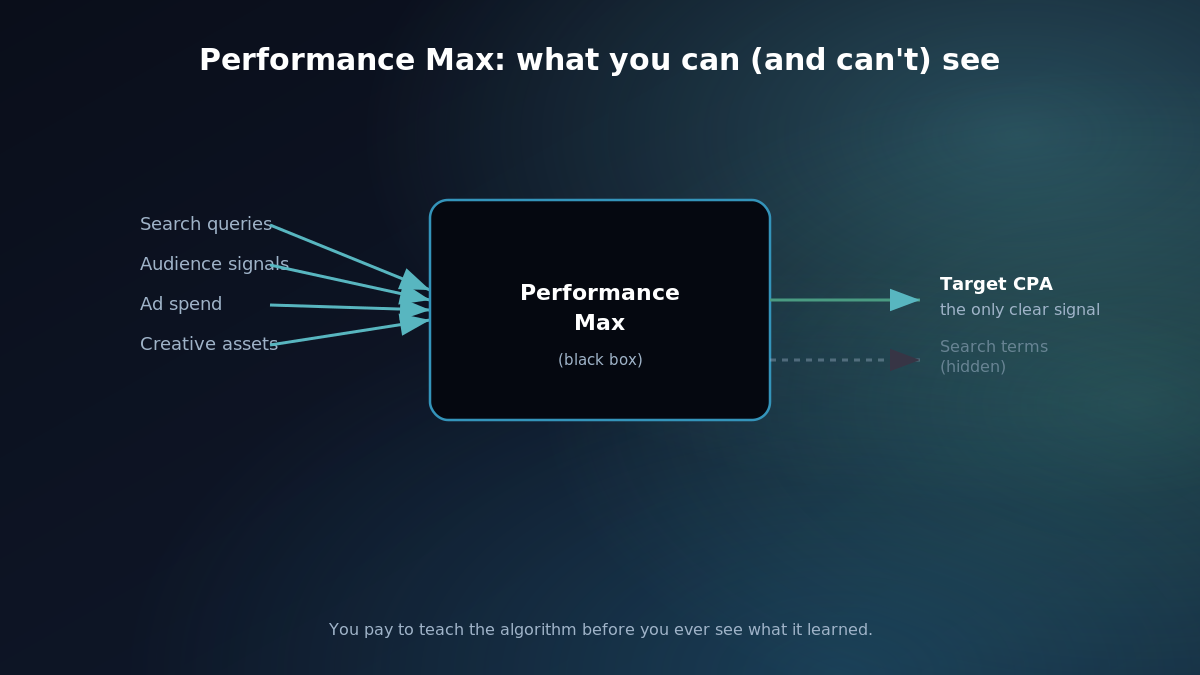
Performance Max (PMax) campaigns are one of Google's most well-known automated products. They combine several channels: Search, Display, YouTube, Discover, all under a single umbrella. You provide creative assets, some targeting parameters, and a goal (like a CPA target), and Google's machine learning handles the rest.
But many advertisers call PMax a "black box," and it's worth looking at why.
Limited visibility into search terms
Traditionally, if you run a Search campaign, you can open a Search Terms report to see exactly what users typed before clicking on your ad. In Performance Max, Search Term data is not normally reported, resulting in a "black box" with only the smallest of glimpses on the Insights tab. This lack of Search Term and distribution data visibility means you are unable to optimize away from irrelevant and potentially costly Search Terms.
Fans of Performance Max would say, "Google's algorithm will learn and optimize away poor traffic eventually. You don't need to worry about search terms if you're getting the desired CPA." But without visibility and the ability to fine tune results, you're reliant on spending real ad dollars on the promise of "eventually." PMax slowly learns at your expense, and you're forced to take Google's word for it that these dollars were spent efficiently. The lack of transparency suggests there's data Google isn't eager to show. Reaching a desired CPA isn't enough: a well optimized campaign should be maximizing conversion volume within the constraints of a viable CPA target.
Its true that machine learning can eventually spot some patterns of irrelevance, but only after you've paid for enough clicks to teach it. Google's "learning phase" of machine learning is an expense passed onto the advertiser. If you already know to exclude certain terms, or if you suspect certain queries might be unprofitable, just block them. As an account matures, continually prune non-relevant search terms from the campaign or ad group. Performance Max doesn't make that easy, so you end up spending more than you need to on "learning" and optimization.
Brand traffic masking
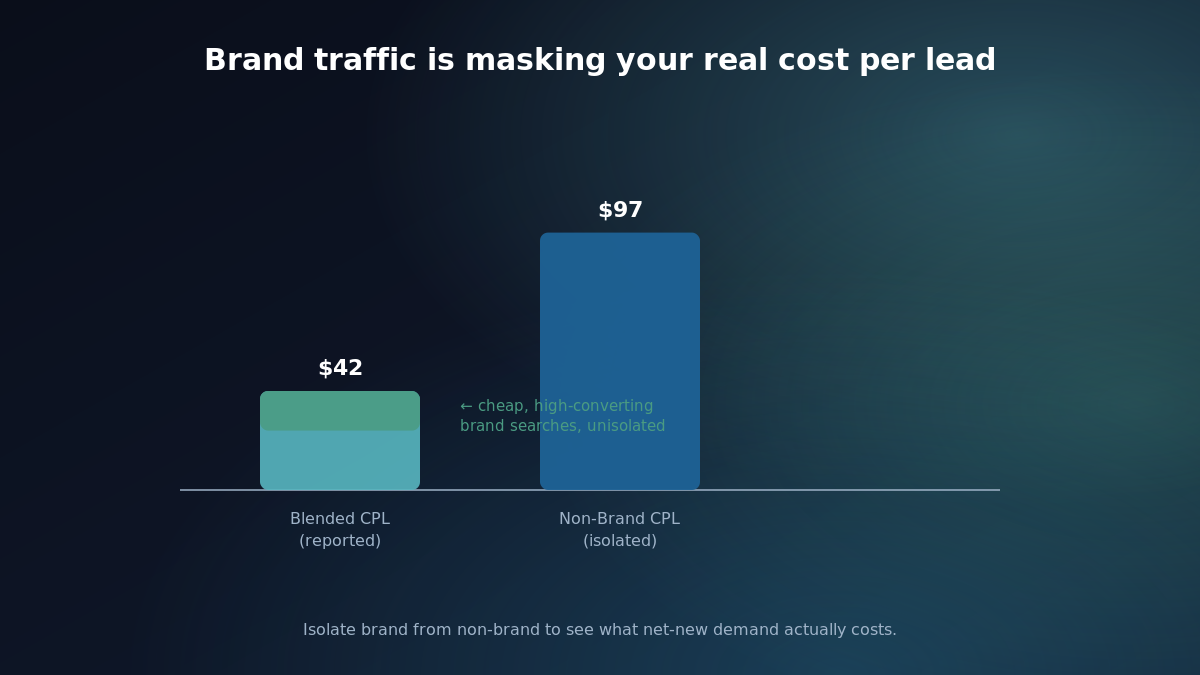
Another frequent issue with Performance Max is how it handles brand traffic. Brand searches, like someone typing "[Your Brand Name] dresses," are typically high-converting and low-cost because you're relevant to your own name. If PMax lumps these brand searches in with all your other traffic, your campaign metrics can look fantastic, but that success might be heavily padded by brand terms and masking ad spend waste on non-branded search terms.
If you don't isolate brand terms, you don't have a clear view of how well you're doing in capturing net new audiences. You might see a good Cost Per Lead, but 50% (or more) of your conversions could be people who were already looking for your brand. So you're misled into thinking your campaign is performing better than it truly is.
Brand traffic is cheap and high-performing and is a valid part of your portfolio, but it needs to be isolated and optimized separately from your non-branded keywords in order to maximize coverage and efficiency. PMax masks these terms and can cannibalize these terms unless you set up brand exclusions, though many advertisers aren't even aware that's an option.
Separate your brand campaigns. If your brand is strong enough to generate frequent search traffic, that's great, but it's a different beast than generic or competitor terms. To get an accurate read on your performance, isolate brand terms so you can properly evaluate how well you're reaching new prospects.
Where automation shines and where it lacks
You might think that we're anti-Google Ads automation. That's not the case. In fact, we believe certain aspects of Google's automation have become extremely effective, notably its bidding algorithms. Campaign types like Performance Max (PMax), dynamic search and so on are fantastic options in combination with a strong search only campaign structure.
Bidding algorithms: a legitimate advantage
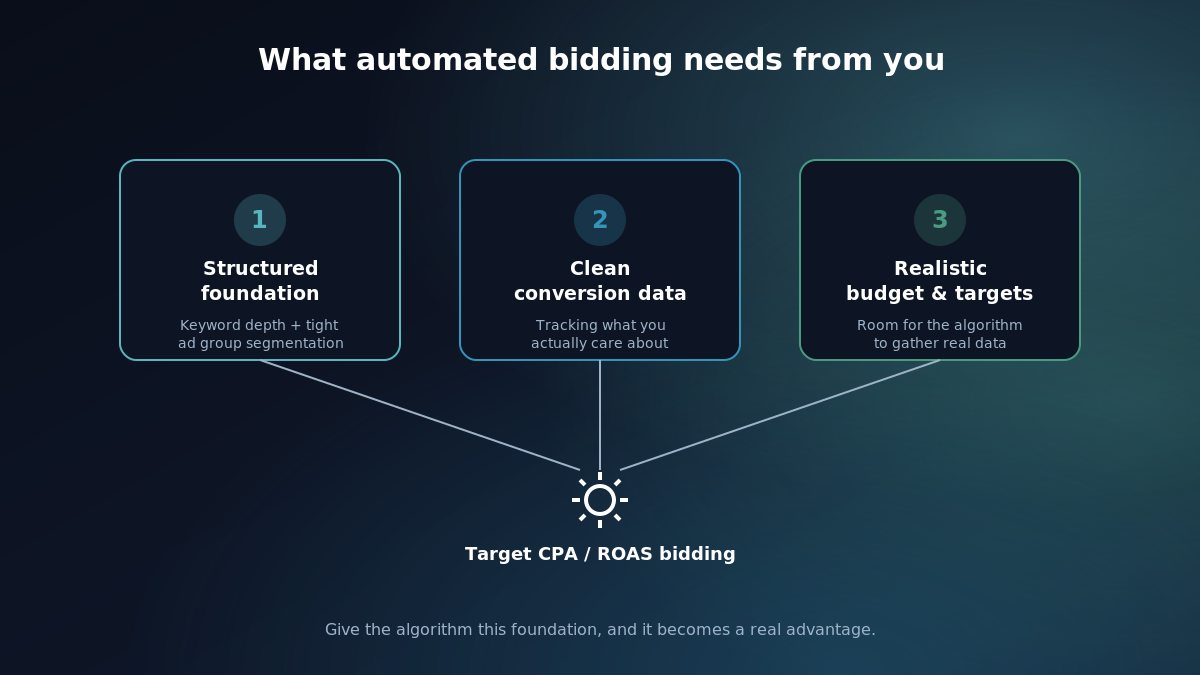
Google's automated bidding, whether it's Max Conversions with a Target CPA or Target ROAS, can be a genuine asset if you provide the right signals. In an ideal scenario, you have a well structured campaign foundation (or set of campaigns) with relevant keyword detail and ad group segmentation, clean conversion data that tracks the metrics you truly care about (sales, qualified leads, etc.), and enough budget to let the algorithms gather data without constantly being budget-constrained.
When that's in place, Google's machine learning can be very effective at adjusting bids in real time, factoring in dozens or even hundreds of signals, like device type, time of day, audience segments, or past user behavior. These are details a human paid search manager might struggle to optimize continuously. Our experience and multiple studies have shown that when used correctly, automated bidding can outperform manual bidding in terms of stable, predictable CPAs or ROAS goals.
The transparency gap
However, automation falls apart if you're not able to see and respond to what's really going on. If the system decides to run your ads on irrelevant or low-intent searches and you never see those queries in a report, you can't correct the course. You are blind to the data, and you can't add negative keywords for patterns that are hidden from you. Sure, the algorithm might eventually weed them out, but not before you've spent valuable budget (and time) essentially training Google's system.
Many paid search managers, agencies and Google claim that partial data visibility shouldn't matter: what counts is your final CPA or ROAS. But that's not entirely accurate, even when you're hitting the target.
That argument only holds if you aren't interested in growth. Even if your CPA looks good, you are sacrificing scale potential and missing out on more profitable subsets of traffic by allowing inefficiencies to fester outside of your view and positive themes to remain under-tapped. Transparency isn't just about cost control; it's also about finding new opportunities to expand and grow your business.
Balancing automation with strategy
Automation can be beneficial and risky at the same time. My recommendation is to treat Google's automated features as one tool in your arsenal, not the entire foundation of your paid search strategy. Think of it like hiring an assistant: they can handle a lot of day-to-day tasks, but you, as the strategist and paid search manager, should still build the right foundation for success.
Concrete steps to implement a better automation approach
Run a separate brand campaign if possible so you can keep an eye on brand versus non-brand results. This helps you see your real cost and conversion metrics for new audiences.
Don't just rely on broad match keywords with automated bidding. Build out your exact and phrase match keywords, create tightly themed ad groups to control relevance and messaging, and go as deep as possible with keyword depth, ad groups, hyper relevant ads, and landing page alignment. Then layer on Target CPA or Target ROAS with Maximize Conversions on top of this solid foundation for best results.
Keep researching negative keywords, continuously. If you're not reliant on Performance Max, regularly check your Search Terms reports and add negatives. If you're using PMax, push for brand exclusions and coordinate with Google reps for advanced negative keyword implementation. Don't assume Google "learns" everything quickly. When revenue isn't tracked in Google Ads, optimizing toward lead quality and lead values becomes imperative. Not all leads are created equal.
Automated bidding algorithms need some wiggle room to gather data, so set realistic targets. If your CPA target is set too low, the system might starve for data and make erratic bids, or fail to serve ads at all. By contrast, a balanced target gives Google's algorithm the freedom to test and find your best audiences.
Paid search management is not a set it and forget it channel, so keep monitoring and refining. Regular analysis and optimization are needed to win versus your competitors in the bidding auction. Just because a campaign looks good at first pass doesn't mean you can let it run unchecked. The goal should be to improve performance and extract as much value as possible from each dollar invested. Increasing your lead volume and decreasing cost per lead requires knowing what levers to pull and when to pull them.
Beyond the hype, and why I remain steadfast in my approach to paid search
People often ask why we don't simply hand over full control of our clients' ad budgets to Google. Here are the objections we hear most, and our take on each.
"Automation saves time and money"
Yes, if your goal is just to run ads without hiring a dedicated experienced expert, automation can help. But for advertisers aiming for sustained growth or market domination, you need more than baseline results. High-level success requires a more hands-on approach in combination with effective automation. Likewise, if your goal is to differentiate yourself as a high performing paid search manager or agency, you'll have to reframe your success as your client's paid search account growth, not your return on effort.
"Google's AI knows more than any human could"
Google's AI does process more data in real time than we can, but data processing alone doesn't equal strategic success. Humans excel at context, specific strategies, creative problem-solving, and forward-thinking. A purely reactive system, no matter how sophisticated, lacks the foresight to interpret business nuances the way a human expert can. Today, "AI plus human" is better than AI without a human.
"Our agency says it's industry best practice"
Many agencies tout "best practices" that align closely with Google's official guidelines. But best practices do not mean best results. Google best practices might be fine for cookie-cutter accounts, but it often leaves significant performance gains on the table. Best practices are a starting point, not the finish line. True competitive advantage comes from going beyond those defaults.
"We're happy with our current CPL/ROAS"
If you're genuinely satisfied, that's great. But I always encourage advertisers to consider: could you get more volume at the same cost per lead? Could you lower your CPL while keeping volume stable? Do you have any control in influencing either of those outcomes, or did you hand off control to Google? Without deeper control and transparency, you may never know what your growth potential is. You may not be able to answer whether you're getting the right leads or conversions.
Automation as an aid, not a crutch
I've worked in paid search from a lot of different angles. I started at a small agency trying to make sense of paid search when it was still new, then spent time at a larger agency managing massive enterprise accounts, and now I run SEMOptimize, where we handle high-growth campaigns for businesses determined to grow and control their own destiny. Automation isn't something I'm fundamentally against. In fact, I'd say we regularly use and even champion certain automated bidding strategies for clients. Our own tech stack includes proprietary and customizable tools and automation specific to building a great foundation for paid search success.
But we never forget that Google's endgame is to boost its own revenue and to appeal to the natural tendency of people to find an easier way rather than the best way. If you're not paying close attention, it's all too easy to overspend or remain complacent with suboptimal results. Performance Max, auto-apply suggestions, and other "set it and forget it" systems can inadvertently blindfold you to crucial details, like irrelevant search queries or the extent of brand traffic subsidizing inefficiencies.
That's why I urge advertisers who are serious about growth to keep a firm hand on the steering wheel. By all means, use the tools that Google has provided, but do so with vigilance and expert guidance. Create keyword detail, ad customization and meaningful campaign segmentation, then continuously refine with negative keywords and analyze performance beyond the surface-level metrics that Google showcases.
If you adopt this balanced approach, you'll harness the best of both worlds: the speed and scale of machine learning, plus the strategic oversight only an experienced human can provide. In a crowded and competitive paid search environment, that combination often makes the difference between merely "acceptable" results and genuine business growth.
Jared Schroder is available for speaking engagements, webinars, training, and guest blog posts on how to maximize your ROI in Google Ads and paid search.
SEMOptimize specializes in paid search for both B2B and B2C lead generation, helping companies maximize the long-term value of their ad spend. Business success isn't for everyone, that's why we've learned to be very selective of what clients we bring on to the SEMOptimize platform.
Contact us today for a free consultation and to see if SEMOptimize is the right partner for you.